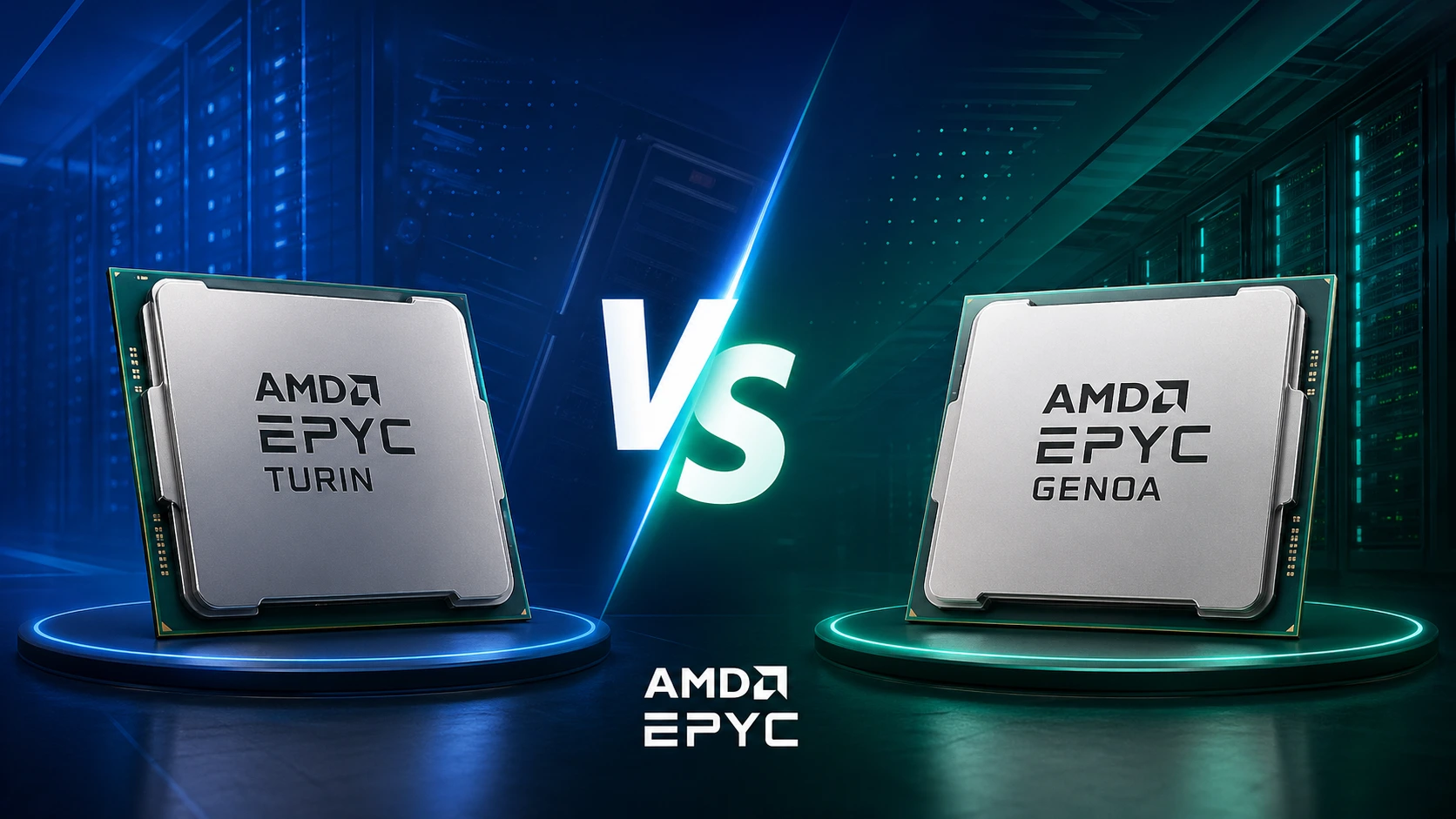
If you are comparing AMD EPYC Turin vs Intel Xeon 6 for a dedicated server in 2026, you are in the right place. This guide breaks down real-world performance benchmarks, price-to-performance ratios, power efficiency data, and exact use-case recommendations — so you can confidently choose the best server CPU for your workload without overpaying.
The 2025–2026 server CPU generation is one of the most competitive in a decade. AMD's EPYC Turin (Zen 5 architecture) raised the bar on core density, while Intel's Xeon 6 family split into two distinct camps: Sierra Forest for efficiency-focused, high-density E-core deployments, and Granite Rapids for single-threaded, latency-sensitive P-core workloads.
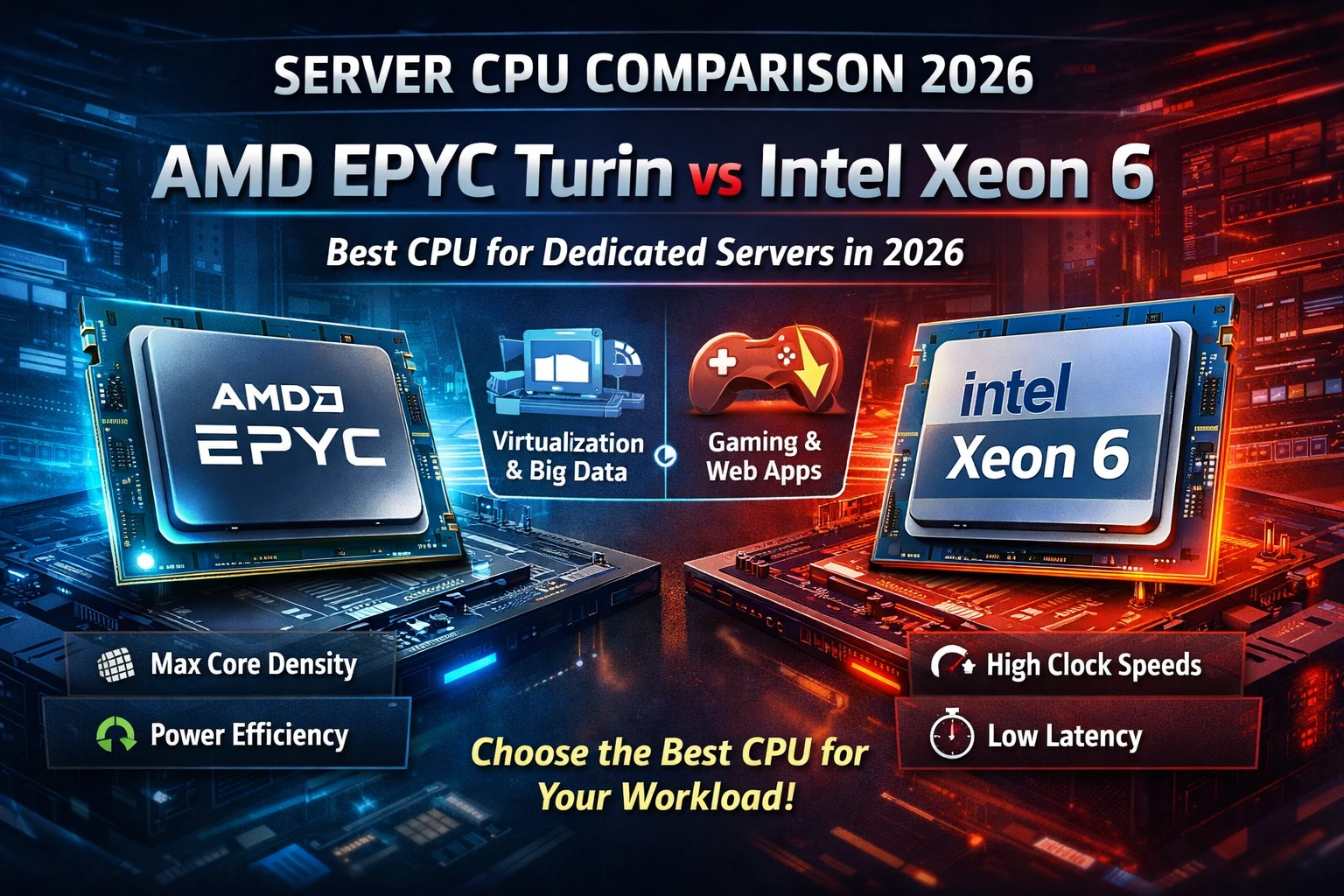
AMD EPYC Turin wins on core density and TCO; Intel Xeon 6 Granite Rapids wins on single-thread speed. Your workload determines the winner.
Quick Specs: AMD EPYC Turin (Zen 5) vs Intel Xeon 6 — 2026 Single-Socket Comparison
| Feature | AMD EPYC Turin (Zen 5) | Intel Xeon 6 (Sierra Forest / Granite Rapids) |
|---|---|---|
| Architecture | Zen 5 (Turin / Turin Dense) | Sierra Forest (E-core) / Granite Rapids (P-core) |
| Max Cores — Single Socket | 192 (Turin Dense) / 128 (Turin) | Up to 288 E-cores / Up to 128 P-cores |
| Max Threads | 384 | 288 (E-core) / 256 (P-core) |
| Process Node | 4 nm / 3 nm (TSMC) | Intel 3 |
| Max Memory Channels | 12 (DDR5-6000+) | 8–12 (DDR5-6400 / MRDIMMs) |
| Max Memory Capacity | Up to 6 TB | Up to 8 TB+ (MRDIMMs) |
| PCIe Lanes | 128 (PCIe 5.0) | 88–136 (PCIe 5.0 / CXL 2.0) |
| TDP Range | 200–500 W | 205–500 W |
| Dedicated Server Starting Price | $55–$220/mo | $70–$250/mo |
* 86-core Granite Rapids SKUs remain the most common enterprise deployment in 2026; 128-core models are available at the high end.
Real-World Performance Benchmarks: AMD EPYC Turin vs Intel Xeon 6 (2026)
1. Multi-Threaded Workloads: Virtualization, Databases, Big Data
Winner: AMD EPYC Turin
For CPU-intensive server workloads that rely on high core counts — including KVM/Proxmox virtualization, Docker container clusters, Elasticsearch, Apache Hadoop, PostgreSQL large joins, and FFmpeg video encoding — AMD EPYC Turin is the clear leader in 2026.
-
128-core EPYC Turin: Best price-to-performance ratio for mid-range enterprise virtualization.
-
192-core Turin Dense: Maximum VM density per rack unit — ideal for cloud hosting providers and large-scale VPS infrastructure.
-
Intel Sierra Forest (E-cores): Competitive on power efficiency but trails AMD by 15–30% in raw multi-thread throughput on database and virtualization benchmarks.
If your primary metric is virtual machines per dollar or Hadoop job throughput per watt, AMD EPYC Turin is the best dedicated server CPU on the market today.
2. Single-Threaded & Latency-Sensitive Workloads: Game Servers, Web, Redis, Memcached
Winner: Intel Xeon 6 Granite Rapids
When clock speed and Instructions Per Clock (IPC) matter more than raw core count, Intel Xeon 6 Granite Rapids P-cores dominate. Granite Rapids regularly hits boost frequencies of 5.0–5.7 GHz in server environments, making it the top choice for:
-
Game server hosting (Minecraft, Rust, ARK: Survival Ascended, FiveM, CS2) requiring high tick rates and low-latency processing.
-
High-QPS web front-end servers where per-request response time is critical.
-
In-memory caching layers (Redis, Memcached, KeyDB) that are bottlenecked by single-thread speed.
-
Real-time applications and financial trading systems demanding sub-millisecond latency.
For game server dedicated hosting in 2026, Intel Xeon 6 Granite Rapids is the best CPU option available — full stop.
3. AI Inference & Machine Learning Training: CPU + GPU Dedicated Servers
Winner: Tie (GPU pairing is the deciding factor)
Both AMD EPYC Turin and Intel Xeon 6 deliver the massive PCIe 5.0 bandwidth required for modern AI workloads. The GPU you pair with them matters far more than which CPU you choose for pure AI training performance.
-
AMD EPYC Turin: Slight edge on CPU-side preprocessing, data pipeline throughput, and loading large training datasets — thanks to higher core counts and memory bandwidth.
-
Intel Xeon 6 Granite Rapids: Advantage in mixed CPU+GPU inference workloads with advanced AVX-512 acceleration and Intel QuickAssist Technology (QAT) for compression and cryptography offload.
For GPU-accelerated AI dedicated servers, pair either CPU with NVIDIA H100 SXM, NVIDIA B200, or RTX 5090 GPUs depending on your budget and workload type.
4. Power Efficiency & Total Cost of Ownership (TCO): Long-Running Server Workloads
Winner: AMD EPYC Turin (Narrow Edge)
Manufactured on TSMC's 4 nm and 3 nm process nodes, AMD EPYC Zen 5 achieves a measurably lower TDP at equivalent core counts versus Intel Granite Rapids P-cores. For 24/7 server workloads, this translates to a real-world Total Cost of Ownership (TCO) advantage of roughly 10–25% — material savings at scale when you factor in electricity and cooling costs.
Intel Sierra Forest E-cores close this efficiency gap significantly at light or idle loads. If your servers spend significant time at low utilization, Sierra Forest becomes more competitive on a power-per-task basis.
Dedicated Server Price vs Performance: AMD EPYC Turin vs Intel Xeon 6 by Use Case (2026)
| Use Case / Workload | Best CPU Choice | Starting Price | Recommended Config |
|---|---|---|---|
| High-Density VM / Container Hosting | AMD EPYC Turin 128–192 Core | ~$89/mo | 128 cores, 512 GB DDR5, 2× 3.84 TB NVMe |
| Game Server Hosting (Low Ping) | Intel Xeon 6 Granite Rapids | ~$79/mo | 64 P-cores, 256 GB RAM, 2× 1.92 TB NVMe, 10 Gbps |
| AI Inference & ML Training | Either + NVIDIA GPU | ~$199/mo | 64–96 cores + 4× RTX 5090 or 2× H100 |
| High-Traffic E-Commerce | Intel Xeon 6 or AMD Turin | ~$69/mo | 64 cores, 256 GB RAM, NVMe RAID-10, 10 Gbps |
| Large Databases & Big Data Analytics | AMD EPYC Turin Dense | ~$119/mo | 192 cores, 1 TB RAM, 4× 7.68 TB NVMe |
Final Verdict: Which Server CPU Should You Choose in 2026?
| Your Priority | Recommended CPU (2026) | Key Reason |
|---|---|---|
| Maximum Core & Thread Count (Virtualization, Big Data) | AMD EPYC Turin | Up to 192 cores; best multi-thread performance per dollar available. |
| Highest Single-Thread Clock Speed (Gaming, Redis, Web) | Intel Xeon 6 Granite Rapids | 5.0–5.7 GHz boost clocks; superior IPC on latency-sensitive code. |
| Lowest TCO & Power Bill (24/7 Sustained Workloads) | AMD EPYC Turin | TSMC 3–4 nm efficiency; 10–25% lower power costs at scale. |
| GPU-Heavy AI/ML Dedicated Servers | Tie | Both offer PCIe 5.0 bandwidth; GPU choice is the real differentiator. |
| Mixed Workloads / General Purpose Hosting | AMD EPYC Turin | Strongest all-round value — most modern workloads favor core count. |
Not sure which dedicated server CPU fits your specific workload? Our team provides free configuration recommendations — no commitment required.
Frequently Asked Questions: AMD EPYC Turin vs Intel Xeon 6
Is AMD EPYC Turin better than Intel Xeon 6 for dedicated server hosting?
For most multi-threaded server workloads in 2026 — including virtualization, container hosting, big data, and database servers — AMD EPYC Turin offers better performance per dollar. Intel Xeon 6 Granite Rapids is the better choice specifically for single-threaded, latency-sensitive applications like game servers, Redis caching, and real-time web services.
What is AMD EPYC Turin Dense?
Turin Dense is a higher-density EPYC variant that packs up to 192 Zen 5 cores into a single-socket processor. It is optimized for maximum VM density, large-scale container orchestration, and big data workloads where core count per rack unit is the primary optimization target.
Is Intel Xeon 6 good for game server hosting?
Yes. Intel Xeon 6 Granite Rapids P-cores are currently the best CPU choice for game server hosting in 2026. Their high single-thread boost clocks (5.0–5.7 GHz) and superior IPC directly translate to lower tick-rate latency in games like Minecraft, Rust, ARK, FiveM, and CS2.
How does AMD EPYC Zen 5 compare to Intel Xeon 6 on power efficiency?
AMD EPYC Turin built on TSMC's 4 nm and 3 nm nodes holds a 10–25% advantage in power efficiency over Intel Xeon 6 Granite Rapids P-cores under sustained, high-utilization workloads. Intel Sierra Forest E-cores are more competitive at idle and light loads.
Which CPU is best for AI and machine learning dedicated servers?
For GPU-accelerated AI workloads, the GPU itself (NVIDIA H100, B200, or RTX 5090) has far more impact on training and inference speed than the host CPU. Both AMD EPYC Turin and Intel Xeon 6 provide sufficient PCIe 5.0 bandwidth and CPU preprocessing power. AMD has a slight edge on data pipeline throughput; Intel wins on specific AVX-512 accelerated inference tasks.
Why Choose KW Servers for Your AMD or Intel Dedicated Server?
Whether you deploy on AMD EPYC Turin or Intel Xeon 6, the hosting environment matters as much as the CPU. KW Servers offers:
-
Global Reach: Instant dedicated server deployment across 250+ worldwide locations.
-
DDoS Protection: Free network-level DDoS mitigation up to 10 Tbps — included at no extra cost.
-
Bare-Metal Performance: Full hardware control with zero noisy-neighbor interference.
-
Flexible Configurations: High-core AMD builds to high-clock Intel options, plus powerful GPU add-ons for AI workloads.
-
Competitive Pricing: Enterprise-grade AMD and Intel dedicated servers starting from $30/month (Asia and Africa regions).
-
Expert Support: 24/7 access to real data center engineers — not tier-1 scripts.
Ready to deploy? View AMD EPYC Turin Dedicated Servers | View Intel Xeon 6 Dedicated Servers | Browse GPU Dedicated Servers
Have a question about AMD EPYC Turin vs Intel Xeon 6 for your specific workload? Drop a comment or contact our team — we will recommend the best configuration for free.