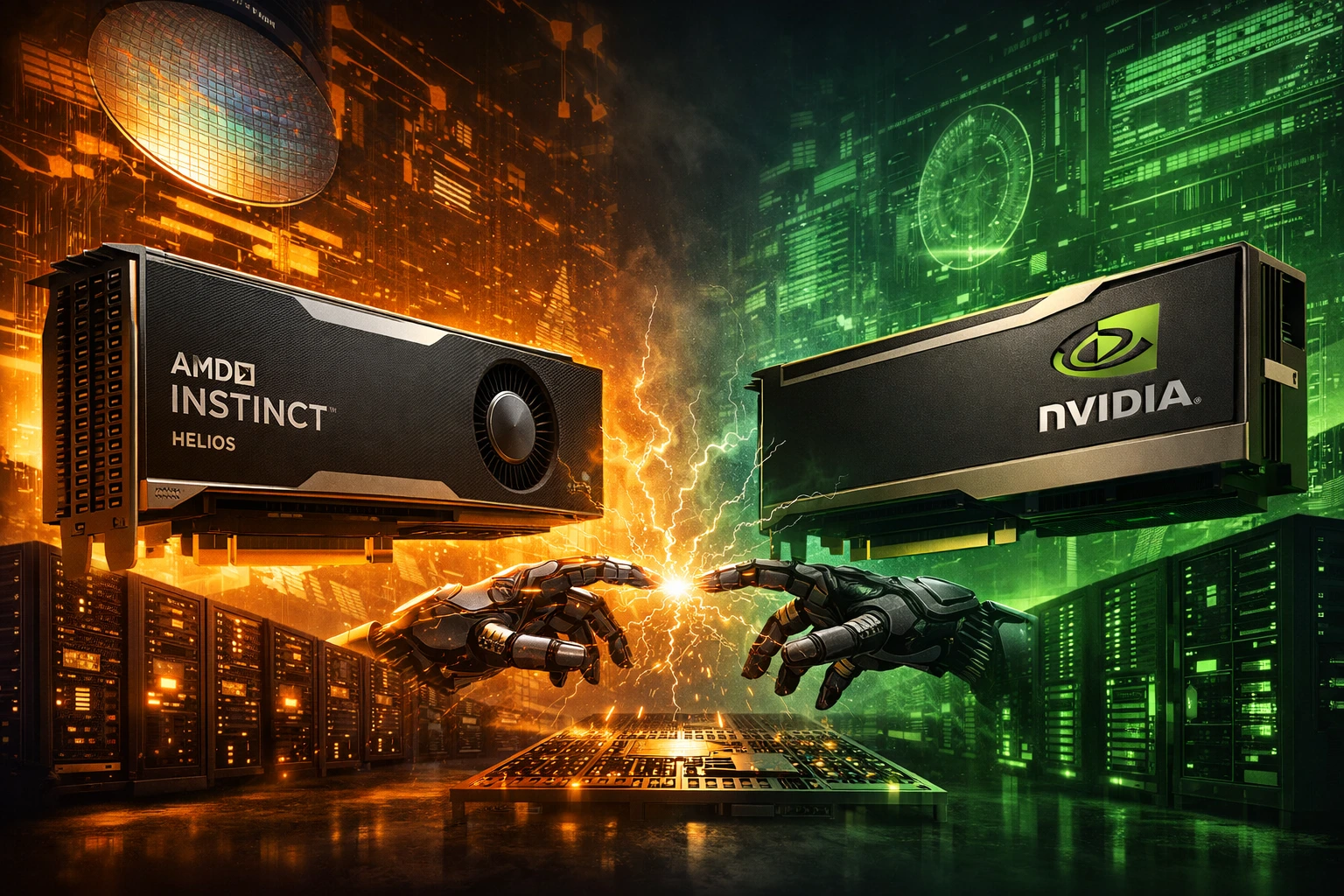
NVIDIA has controlled the AI compute market for over a decade, largely unchallenged. But 2026 is shaping up differently. AMD's Instinct MI400 series, reportedly codenamed "Helios" and expected to be built on the next-generation CDNA 4 architecture, is the most credible hardware rival NVIDIA has faced in the GPU compute space. And for organizations running bare metal dedicated GPU servers, the timing couldn't be more significant.
This article consolidates what we know from AMD's official roadmaps, partner briefings, and architectural disclosures so you can make an informed decision about your AI infrastructure spending before committing to another NVIDIA Blackwell deployment.
1. AMD Instinct MI400 — Expected Architecture and Projected Specifications
AMD has outlined next-generation Instinct GPUs in its data center roadmap, targeting a late 2026 to early 2027 general availability window. The MI400 is expected to be built on CDNA 4, AMD’s dedicated compute architecture, and manufactured on TSMC’s 3nm-class N3P/N3X process. It may leverage a newer node than NVIDIA’s Blackwell, which uses a custom 4nm process, depending on final implementation.
Note: The following MI400 specifications are based on industry projections and have not been officially confirmed.
Expected Specifications at a Glance
| Specification | MI300X (Current) | MI400 (Expected 2026–27) | NVIDIA Blackwell B200 | MI400 Edge |
|---|---|---|---|---|
| Architecture | CDNA 3 | CDNA 4 | Blackwell | Newer generation |
| Process Node | 5nm + 6nm | 3nm-class (N3P/N3X) | 4nm custom | ~1 node ahead |
| VRAM | 192 GB HBM3 | ~288–384 GB HBM4 (projected) | 192 GB HBM3e | 50–100% more |
| Memory Bandwidth | ~5.3 TB/s | ~10–12 TB/s (estimated) | ~8 TB/s | 25–50% higher |
| FP8 / FP4 AI Throughput | ~2.6 PFLOPS | ~8–10 PFLOPS (projected) | ~5–6 PFLOPS | 60–100% faster |
| TDP per GPU | 750W | 900–1,100W | 700–1,000W | Similar range |
| Bare Metal Price (4× config) | $12K–18K/mo | Estimated $10K–15K/mo (subject to market conditions) | $15K–25K/mo | 25–40% cheaper |
| Software Ecosystem | ROCm (maturing) | ROCm (improved) | CUDA (dominant) | NVIDIA leads |
One important consideration often overlooked is power and cooling. GPUs in the 900–1,100W range introduce significant challenges for rack density, thermal design, and power delivery in bare metal environments. For large-scale deployments, infrastructure costs beyond the GPU itself, including cooling and energy, can materially impact the total cost of ownership.
Why HBM4 memory matters for AI workloads: Large language models like LLaMA 4, Grok 4, and upcoming DeepSeek variants are increasingly memory-bound at inference time. Having 288–384 GB of HBM4 per GPU means you can fit significantly larger models inside a single node, reducing inter-node communication overhead and dramatically cutting distributed training costs.
2. AMD Instinct MI400 vs NVIDIA Blackwell B200 — What the Numbers Actually Mean
Raw spec comparisons tell only half the story. Here is what these numbers translate to in practical AI infrastructure decisions for dedicated GPU server deployments.
Memory Bandwidth: The Silent Bottleneck of Modern AI
Most large-scale AI workloads, whether training billion-parameter models or running real-time inference, are constrained by how fast data moves between memory and compute, not by raw floating-point operations. The MI400's projected 10–12 TB/s bandwidth versus Blackwell's ~8 TB/s is a difference that compounds across every layer of a transformer model, every batch, and every training iteration.
FP8 and FP4 Throughput: The Inference Game-Changer
Production AI inference, the kind that serves millions of API requests, runs primarily in FP8 or FP4 precision to maximize throughput and minimize cost per query. The MI400's expected 8–10 PFLOPS in these low-precision formats significantly outpaces Blackwell's 5–6 PFLOPS. For operators running RAG pipelines, multi-modal inference, or high-concurrency chatbot backends, that gap translates directly into fewer GPUs needed or far more requests served per dollar spent.
Price-Performance: Where AMD Changes the Conversation
NVIDIA's hardware premium has historically been justified by its software ecosystem advantage. But when bare metal dedicated servers, not overpriced cloud instances, are the delivery mechanism, the cost math shifts significantly. AMD's aggressive pricing strategy on MI400 targets a 25–40% cost reduction versus equivalent Blackwell configurations. For production AI workloads running 24/7, that represents six-figure annual savings per cluster.
3. Real-World AI Workload Performance — What to Expect from MI400
Based on architectural analysis and early partner data, here is how MI400 is expected to perform across the most common bare metal AI use cases.
Large Model Pre-Training (LLaMA 4, Grok 4, DeepSeek-R2 Scale)
The combination of larger per-GPU memory and higher memory bandwidth means MI400 clusters can sustain significantly larger batch sizes without spilling to slower interconnects. Early projections indicate potential reductions in training time depending on workload characteristics and cluster size compared to equivalent NVIDIA Blackwell deployments at frontier scale.
High-Throughput Inference and LLM API Serving
For inference workloads, particularly serving large language models at scale via APIs, the FP8/FP4 throughput advantage is the dominant performance factor. This could deliver substantial improvements in tokens per second per GPU depending on model architecture and optimization directly reducing cost per million tokens served. For companies whose product is an AI API, this metric matters more than any other.
Retrieval-Augmented Generation (RAG) and Vector Search Workloads
RAG pipelines stress both compute and memory simultaneously, embedding generation, vector search, and LLM inference happen in rapid succession. More per-GPU memory means larger embedding caches and extended context windows without paging to slower storage, reducing end-to-end latency on complex retrieval chains.
Multi-GPU Scaling on Bare Metal Infrastructure
With AMD's Infinity Fabric interconnect and a maturing ROCm software stack, multi-GPU scaling efficiency is expected to improve, especially for single-node configurations. AMD’s interconnect approach is more open than NVIDIA’s NVLink/NVSwitch ecosystem, which may benefit organizations seeking flexibility, while NVIDIA continues to hold an advantage in mature, large-scale interconnect performance.
Important caveat on software maturity: ROCm has improved substantially through 2025 and 2026, but CUDA's software ecosystem remains deeper and more battle-tested. If your AI stack heavily uses CUDA-specific libraries cuDNN, TensorRT, or custom flash attention implementations, migrating to ROCm requires dedicated validation testing. Factor this into any MI400 adoption timeline.
CUDA continues to benefit from a deeply integrated ecosystem, including libraries like TensorRT and cuDNN, which remain heavily optimized for production AI workloads. This depth of support contributes to faster deployment times and higher stability in real-world AI infrastructure.
4. MI400 Availability Timeline — When Can You Actually Deploy?
-
Now through Q3 2026: NVIDIA Blackwell B200 is available on bare metal dedicated servers and remains the best option for immediate deployments. MI300X remains a solid ROCm-compatible alternative for teams willing to invest in AMD's software stack today.
-
Q4 2026: AMD MI400 initial silicon and limited samples arrive. First access goes to hyperscalers and strategic OEM partners. Expect the first credible third-party benchmarks and performance disclosures to emerge during this period.
-
Q1–Q2 2027: General availability through dedicated bare metal GPU server providers. KW Servers plans to offer MI400 configurations as soon as stable ROCm drivers and production-grade firmware are confirmed with our hardware partners.
-
Mid-2027 onward: Mass market adoption. Expect 30–50% of new bare metal AI infrastructure decisions to seriously evaluate MI400 alongside NVIDIA Blackwell and the upcoming Rubin architecture.
5. Who Should Wait for AMD MI400 — And Who Shouldn't
This is not a one-size-fits-all answer. The right choice depends on your workload type, deployment urgency, and the flexibility of your existing software stack.
Consider Waiting for MI400 If…
-
You are planning a major AI cluster build in 2027.
-
Your workloads are memory-bandwidth-constrained large model training, long-context inference, or dense embedding pipelines.
-
You want to reduce dependence on NVIDIA's proprietary ecosystem over the long term.
-
You are price-sensitive, and the projected 25 – 40% cost reduction justifies a wait.
-
Your team runs open-source model stacks PyTorch, JAX, vLLM, where ROCm support has matured considerably, and where AMD dedicated server infrastructure is already a proven fit.
Stick with NVIDIA Blackwell If…
-
You need to deploy AI infrastructure in 2026 and cannot afford to delay product timelines.
-
Your codebase is deeply CUDA-optimized through TensorRT, cuDNN, or custom CUDA kernels that would require significant refactoring.
-
You need guaranteed access to large quantities of GPUs immediately and want the stability of the world's most mature GPU compute ecosystem. In that case, Intel dedicated servers are also worth evaluating for CPU-bound preprocessing pipelines that feed your GPU cluster.
6. How KW Servers Is Preparing for MI400 Bare Metal Clusters
We are actively working with AMD and our data center partners to bring MI400 series GPUs into our bare metal dedicated server lineup as soon as they reach production stability. Here is what you can expect from KW Servers MI400 configurations when they launch.
-
Full Infinity Fabric interconnect: 4× and 8× GPU configurations with AMD's native GPU-to-GPU interconnect, eliminating the bandwidth bottlenecks that plague PCIe-linked multi-GPU setups.
-
288–384 GB HBM4 per GPU: The largest per-GPU VRAM available on any bare metal platform designed for frontier-scale models and extended-context inference workloads that exhaust Blackwell's 192 GB per card.
-
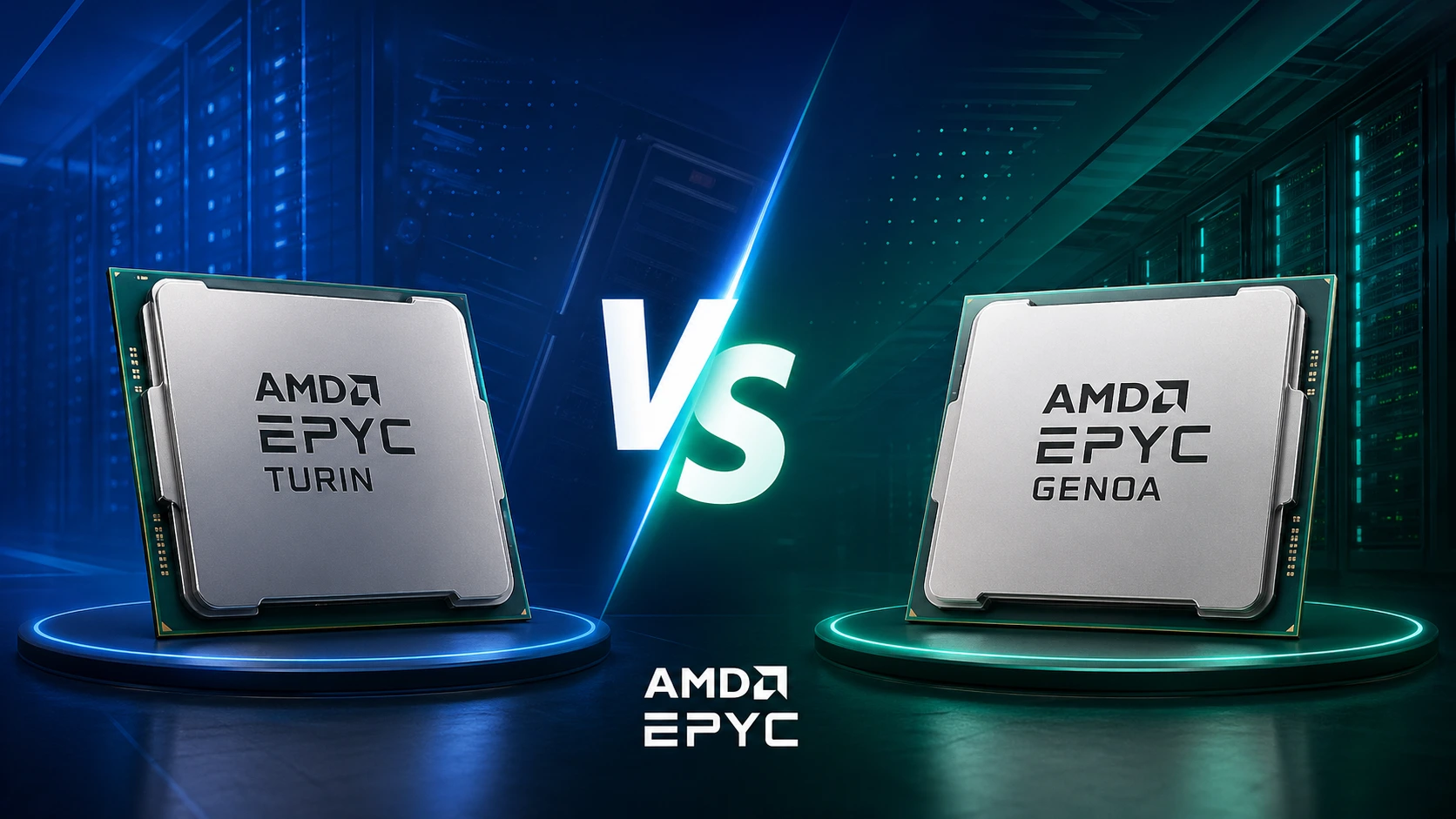
AMD EPYC Turin host CPUs: High-core-count processors optimized for data preprocessing, tokenization pipelines, and efficient GPU feed operations to eliminate CPU bottlenecks in training loops.
-
High-throughput networking built in: MI400 clusters will ship with 10 Gbps dedicated connectivity as standard, with unmetered dedicated server options for workloads that generate sustained high data volumes and full DDoS-protected dedicated server configurations for production AI APIs exposed to the public internet.
-
250+ global deployment locations: USA, Canada, Singapore, Hong Kong, Tokyo, Seoul, and over 250 additional locations. Match your infrastructure to your latency and compliance requirements.
-
Fixed monthly pricing: No cloud-style variable billing. MI400 clusters are expected to undercut equivalent Blackwell configurations by 25% – 40% on a predictable fixed monthly rate.
7. Bottom Line — Is AMD Instinct MI400 Worth Waiting For?
For organizations building long-term AI infrastructure, yes, MI400 is worth planning around. The CDNA 4 architecture, HBM4 memory stack, and AMD's aggressive pricing posture together represent a genuine competitive shift in the dedicated GPU compute market. This suggests a meaningful shift, with AMD closing the gap not just on paper specifications but also in practical deployment scenarios.
For organizations that need to ship AI products in 2026, NVIDIA Blackwell remains the practical choice. Software ecosystem depth, driver maturity, and immediate availability are real advantages that raw hardware specifications do not override.
The wisest approach for most teams is a hybrid planning strategy: deploy what you need now on proven Blackwell bare metal infrastructure, while designing your software stack to be ROCm-compatible from the start. Avoiding deep CUDA lock-in today gives you architectural flexibility and real negotiating leverage when MI400 reaches general availability in 2027.
We'll publish full MI400 benchmarks training throughput, inference latency, and cost per token the moment hardware arrives in our data centers. No marketing spin, just raw numbers.
Have questions about MI400 vs Blackwell for your specific workload? Contact our team for a free cost and performance estimate tailored to your infrastructure requirements.
-
Choose your deployment location
-
Request a 2026–2027 AI infrastructure roadmap consultation