Introduction: The Missing Piece in Dedicated Server Security
Most conversations about dedicated server security stop at two checkpoints: encrypting data at rest on disk, and encrypting data in transit across the network. Between those two states sits a gap that's easy to overlook the moment an application decrypts data to actually use it. While that data sits in system memory, standard encryption no longer covers it.
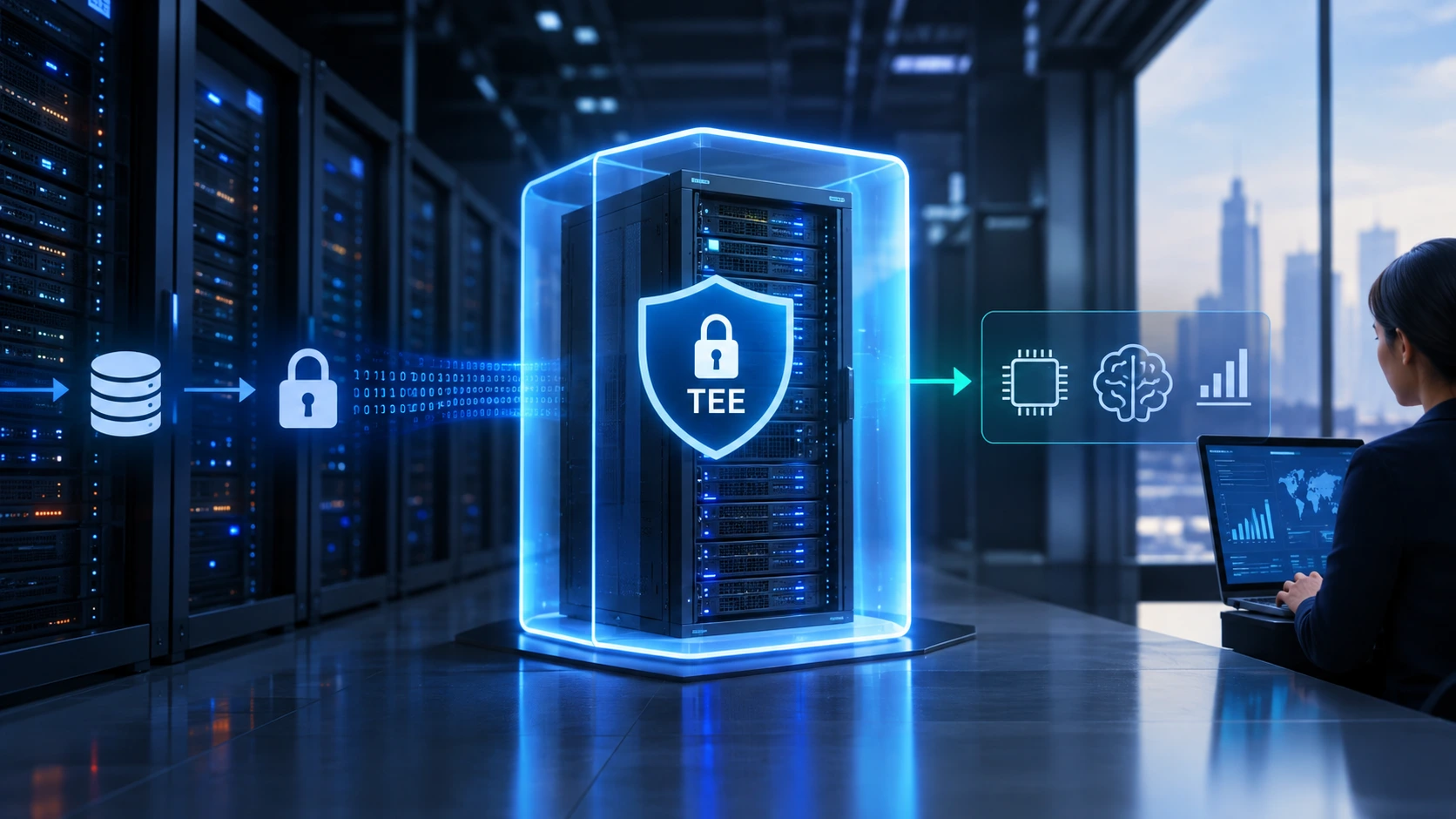
This is the problem confidential computing was built to solve. By pairing dedicated server infrastructure with a Trusted Execution Environment (TEE), organizations can extend hardware-backed protection into the processing stage itself without giving up the raw performance, dedicated resources, and full control that make bare metal servers the preferred choice for demanding workloads like AI, financial services, and healthcare analytics.
This guide breaks down what confidential computing is, how TEEs work on bare metal, and how to evaluate a confidential computing dedicated server for your own workload.
What Is Confidential Computing?
Confidential computing is a security model focused on one specific gap: protecting data in use. It sits alongside two security layers most teams already know well:
-
Encryption at rest: protects data stored on disk
-
Encryption in transit: protects data moving across a network
-
Confidential computing: protects data while it's actively being processed in memory
The core building block is the TEE, a hardware-isolated execution boundary around a workload. Depending on the underlying technology, that boundary might wrap a single application enclave or an entire confidential virtual machine running on a dedicated server.
On bare metal infrastructure, this distinction matters. A dedicated server already gives you direct, unshared access to physical CPU, memory, and storage. A TEE adds a second, hardware-enforced trust boundary on top of that, narrower in scope, but resistant to threats that physical isolation alone doesn't address, including a compromised hypervisor or an over-privileged administrator account.
Why Protecting Data in Use Matters
Sensitive data is usually encrypted before it reaches a server and again once it's written to disk. But somewhere in between, an application has to work with plaintext data to run a query, generate an AI inference, or process a transaction. During that window, the data can exist in system memory in a readable form.
That's a real exposure point in environments where infrastructure software, a compromised hypervisor, or a privileged insider could gain visibility into memory contents. Confidential computing narrows that window by moving the workload into a protected execution environment where even privileged system software outside the TEE can't inspect it.
How a Trusted Execution Environment Works
A TEE combines several mechanisms—hardware isolation, memory protection, workload separation, secure boot, and attestation—into one workflow. Implementation details differ by CPU architecture, but the general process looks like this:
1. Establish a Hardware-Based Trust Boundary
The processor itself creates an isolated environment for the protected workload. The boundary is enforced in hardware, not left to operating-system permissions or hypervisor configuration alone.
2. Protect Memory During Execution
The memory tied to the trusted workload is encrypted or otherwise shielded, so software running outside the TEE can't directly read its contents.
3. Isolate the Workload
The TEE separates the protected application's state from everything else on the system, potentially including the host OS, the hypervisor, other VMs, and other privileged software.
4. Verify the Environment With Remote Attestation
Before any sensitive secrets or keys are released, a relying party can cryptographically verify that the environment is genuine and running the expected, unmodified configuration.
5. Process Sensitive Data Inside the TEE
Once verified, the application receives protected data and processes it inside the trust boundary, limiting what the surrounding infrastructure ever gets to see.
Confidential Computing on Bare Metal Servers
Bare metal servers are physical machines assigned to a single customer—the standard choice when a workload needs predictable CPU performance, high memory capacity, dedicated storage, GPU acceleration, or low-latency networking. Confidential computing doesn't replace any of that; it adds a processor-level security layer on top of it for the specific workloads that need it.
The actual architecture depends on your processor, firmware, OS, and virtualization stack. In practice, the bare metal server acts as the physical foundation, while a confidential VM or protected application enclave becomes the actual trusted execution environment running on top of it.
Intel TDX and AMD SEV-SNP: The Two Leading TEE Technologies
Two technologies dominate VM-based confidential computing on modern server processors.
Intel Trust Domain Extensions (Intel TDX)
Intel TDX creates hardware-isolated virtual machines called Trust Domains, designed to protect the confidentiality and integrity of a VM's memory and CPU state from other software on the platform, including the hosting virtual machine monitor. TDX also supports remote attestation, making it a natural fit for zero-trust and policy-based key-release architectures.
AMD Secure Encrypted Virtualization (AMD SEV-SNP)
AMD SEV is a hardware-based confidential computing feature available on supported EPYC server processors, using encrypted virtual machines to isolate guest workloads from the host and hypervisor. SEV-SNP builds on this with memory integrity protections that guard against threats like malicious memory remapping and replay attacks, plus its own attestation capabilities.
TEE vs. Traditional Server Security: Where It Fits
| Security Layer | Primary Protection | Main Purpose |
|---|---|---|
| Encryption at rest | Stored data | Protect disks, databases, backups |
| Encryption in transit | Network traffic | Protect data moving between systems |
| Access control | Accounts and resources | Limit who can reach systems and data |
| Isolation | Processes and workloads | Separate applications and tenants |
| Confidential computing | Data in use | Protect sensitive workloads during processing |
None of these layers replace the others. A well-designed security architecture combines encrypted storage, TLS, identity controls, network segmentation, hardened operating systems, and confidential computing, each closing a gap the others don't cover.
Remote Attestation: Proving the TEE Can Be Trusted
Encryption alone doesn't answer a critical question: how does an application know its secrets are being released into the correct protected environment, and not a spoofed one?
Remote attestation answers that. The platform generates cryptographic evidence about its configuration; a relying service checks that evidence against a security policy; only after that check passes does a key-management system release the secret. This model means sensitive keys aren't automatically available to the host; access depends on successful, ongoing verification of the TEE itself.
A Practical Confidential Computing Workflow
-
A workload is deployed on a compatible dedicated server and processor.
-
The confidential computing technology establishes the protected execution environment.
-
The platform measures its components and produces attestation evidence.
-
A remote verifier checks that evidence against the required policy.
-
A key-management service releases the required key only after successful verification.
-
The application decrypts and processes sensitive data inside the protected environment.
-
The workload keeps running inside the trust boundary, with monitoring and lifecycle controls still in place.
Use Cases for Confidential Computing on Dedicated Servers
-
Confidential AI and machine learning. AI workloads often touch private customer records, proprietary training data, model weights, or sensitive inference requests. A TEE reduces how much of that is exposed while it's being processed on a GPU server.
-
Financial services. Banks, payment platforms, and fintech applications can use confidential computing as an added layer for sensitive financial data and cryptographic key material.
-
Healthcare data processing. Healthcare analytics regularly involves highly sensitive records; confidential computing helps protect that data during analysis, alongside proper access control, compliance, and logging.
-
Database and analytics workloads. Organizations running proprietary datasets can reduce how much of that sensitive memory is visible to the surrounding infrastructure stack.
-
Multi-party data collaboration. TEEs support scenarios where multiple organizations need to work with shared sensitive data without fully exposing raw records to each other or to infrastructure operators.
-
Proprietary applications and IP. Applications built around valuable algorithms, credentials, or proprietary business logic benefit from hardware-backed isolation and attestation.
Benefits of Confidential Computing on Bare Metal
-
Protects sensitive data during active processing, not just at rest or in transit
-
Adds a hardware-backed isolation layer to your existing security architecture
-
Reduces the trust placed in the host OS or hypervisor for supported confidential VM designs
-
Supports remote attestation and policy-based secret release
-
Fits naturally with sensitive AI, analytics, financial, and healthcare workloads
-
Combines with the raw performance and resource control of dedicated server infrastructure
-
Strengthens data governance and privacy posture when paired with sound operational controls
Limitations and Security Considerations
Confidential computing is not a complete security solution on its own. A TEE protects a defined trust boundary; organizations still need secure application design, identity management, patching, network security, storage encryption, monitoring, backup protection, and incident response around it.
Performance overhead is also real and workload-dependent. Memory encryption, virtualization, attestation, and I/O protection all introduce some cost, so benchmark your actual application rather than assuming uniform performance across confidential workloads.
Hardware support varies too; not every dedicated server supports every confidential computing technology, and support depends on CPU generation, firmware, BIOS configuration, OS, hypervisor, and connected devices. And scope matters: if sensitive data leaves the TEE through an unprotected interface, the security benefit weakens fast. Confidential computing needs to be designed as part of an end-to-end architecture, not bolted on as an afterthought.
How to Choose a Dedicated Server for Confidential Computing
-
Check CPU support. Confirm the Intel Xeon or AMD EPYC platform you're evaluating supports the confidential computing capability your workload needs.
-
Verify firmware and BIOS support. These hardware features often require specific firmware versions and BIOS settings.
-
Confirm OS and hypervisor compatibility. Check that your Linux distribution, Windows environment, KVM, VMware, or other virtualization stack supports the TEE technology you're targeting; see our guide to Linux dedicated servers for compatible builds.
-
Plan attestation up front. Define who verifies the TEE, what measurements are trusted, and what conditions must be met before secrets are released.
-
Protect the key lifecycle. Use a key-management architecture that avoids unnecessarily exposing encryption keys outside the trusted environment.
-
Benchmark the real workload. Measure application performance, memory usage, storage I/O, networking, and accelerator behavior under the actual confidential configuration, not synthetic tests.
-
Review TEE-I/O requirements. If the workload leans heavily on GPUs, NICs, or other PCIe devices, confirm the platform supports confidential-computing protection for those specific devices.
Confidential Computing vs. Dedicated Server Isolation
These two concepts solve related but different problems. Dedicated server isolation keeps one customer's physical resources separate from every other customer's. A TEE goes a level deeper, establishing a protected execution boundary inside that server's own architecture.
For workloads with ordinary performance and privacy requirements, physical isolation, encryption, OS hardening, and strong access controls are often enough on their own. For workloads where data needs to stay protected even from parts of the infrastructure stack itself, confidential computing adds the extra layer.
Confidential Computing for AI on Bare Metal
AI is one of the clearest cases for confidential computing, since training and inference routinely touch valuable IP and sensitive datasets. A TEE can help protect training data, model parameters, prompts, and inference requests while they're actively in use.
One caveat for GPU-based AI infrastructure: a CPU-level TEE alone doesn't automatically extend confidentiality to every connected accelerator or data path. If your threat model requires it, confirm the platform explicitly supports confidential GPU and PCIe device protection—worth checking directly with your GPU server hosting provider.
Security Architecture Example
A practical setup for a sensitive application on a dedicated server might combine:
-
Encrypted storage for data at rest
-
TLS for network communication
-
A confidential VM or application TEE for runtime processing
-
Remote attestation for trust verification
-
A centralized key-management service for controlled secret release
The result is layered protection: data is secured while stored, secured while moving, and given additional hardware-backed protection while it's actually being processed, closing the gap that traditional security models leave open.
Final Thoughts
Confidential computing extends the traditional security model into one of its hardest-to-reach corners: data in use. By combining hardware-backed isolation and memory protection, Trusted Execution Environments keep sensitive workloads protected exactly when they're most exposed—while they're actively being processed.
For anyone running a dedicated server, that's an additional layer of defense that doesn't cost you the predictable resources and control bare metal is chosen for in the first place. Intel TDX, AMD SEV-SNP, and the broader confidential computing ecosystem show how far modern server processors have come in closing this gap.
The right implementation depends on your workload and threat model, so weigh processor support, firmware, OS and hypervisor compatibility, attestation, key management, I/O protection, performance, and compliance requirements before you deploy. Get those pieces working together, and confidential computing becomes a genuinely valuable layer in a modern dedicated server security strategy.
Frequently Asked Questions
What is confidential computing?
Confidential computing is a security approach that protects sensitive data while it's being processed, using hardware-based isolation, memory protection, and trusted execution environments.
What is a TEE?
A Trusted Execution Environment is a protected execution area that isolates sensitive code and data from unauthorized software outside its defined trust boundary.
Can confidential computing run on bare metal?
Yes. Compatible dedicated servers provide the physical hardware foundation for confidential computing; the exact deployment model depends on the processor, firmware, OS, virtualization platform, and TEE technology in use.
Does confidential computing replace encryption?
No. It complements encryption at rest and encryption in transit by addressing the one stage they don't cover: data that's actively being processed.
What are Intel TDX and AMD SEV-SNP?
They're hardware-based technologies designed to protect confidential virtual machines and their memory from unauthorized access by surrounding software.
Is confidential computing useful for AI servers?
Yes, it can protect sensitive AI data, models, and inference workloads. For GPU workloads specifically, verify that the platform also protects connected accelerators and I/O paths.
Does a TEE make a server completely secure?
No. A TEE protects a specific trust boundary. You still need secure software development, patching, identity controls, network security, storage protection, monitoring, and incident response around it.